A switching power supply is an electronic device that converts electrical energy by switching transistors. While a voltage regulator uses transistors biased in the active region of amplification, switching power supplies use the same switch turns at high frequency (100-500 KHz typically) from cut (open) and saturation (Closed). The resulting square waveform is applied to the ferrite core transformers (The iron cores are not suitable for these high frequencies) for one or more output voltages of alternating current (AC) which are then ground (with fast diode) and filtered (inductors and capacitors) for the DC voltajesdesalida (CC).
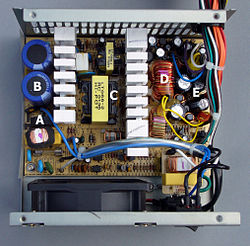
B - Input Capacitor
C - Transformer
D - output filter coil
E - output filter capacitors

Rectifier: converts AC continuously. Llaveador: Under orders from the pulse generator, leads or blocks, at high frequency. Filter: decreases (almost eliminating) the AC at the output, leaving it entirely continuous. Compare: Take a sample of the output, and compares with a reference. Generates an error signal that goes to the pulse generator. Pulse Generator: Generate pulses llaveador go to, to be proportional to the error voltage available at its input.
The AC signal is rectified and converted into pulses continuously. These pulses are delivered to a llaveador, leading, or block, high frequency (typically more than 10,000 Hz.)
The key output is filtered by a normal capacitive. Since switching (llaveamiento) is in high frequency filtering is easy.
A sample of the output voltage. This is applied to a comparator, whose second input has a reference voltage. The comparator takes an error signal that is proportional to the difference between the output and the reference. This error signal is sent to the pulse generator so that it orders the leading Llaveador more or drive less, as needed.
Power Comparison between switched and linear
There are two main types of regulated power supplies available: Switched and linear. The reasons for choosing one type or another can be summarized as follows.
Size and weight - linear power supplies use a transformer operating at a frequency of 50 or 60 Hz. This low frequency transformer is several times larger and heavier than a corresponding transformer switching power supply, which typically operates at frequencies from 50 kHz to 1 megaciclo.La design trend is to use increasingly higher frequencies while the transistors allow to reduce the size of passive components (capacitors, inductors GCA).
Output Voltage - linear power supplies regulate the output using a higher voltage in the previous stages and then dissipating energy as heat to produce a lower voltage, regulated. This voltage drop is necessary and can not be eliminated by improving the design. The switching power supplies can produce output voltages that are lower than the input voltage, the higher the voltage and even reverse the input voltage, making them more versatile and adaptable to varying input voltages.
Efficiency, heat, and power dissipation - A linear regulated supply voltage or leakage current dissipating excess energy as heat, which is inefficient. A switching power supply control signal used to vary the pulse width, taking food only the power required by the load. In all SMPS topologies, turn off and turn on the transistors completely. So, ideally, switching power supplies are 100% efficient. The only heat generated is given by the non-ideal characteristics of components. Losses in switching transistors, direct resistance of saturated transistors, equivalent series resistance in the inductor and capacitors, and voltage drop down the rectifier efficiency. However, optimizing the design, the amount of energy and heat dissipation can be minimized. A good design can have a conversion efficiency of 95%. Typically 75-85% in sources between 10-50W.Las more SMPS efficient use synchronous rectification MOSFET transistor saturated at the right time instead of diodes.
Complexity - a linear regulator is ultimately a power transistor, a voltage regulator IC and a noise filter capacitor. But a typically contains a switching power supply controller IC, one or more power transistors and diodes as well as transformers, inductors, and filter capacitors. Multiple voltages can be generated from the same transformer core. It uses the pulse width control input but different outputs can be difficult for load regulation. Both need a careful selection of processors. In switching power supplies due to operation at high frequencies the losses in the tracks of printed circuit inductance and stray capacitance loss become important. Radio Frequency Interference
- The current in the switching power is abrupt, and contains a large proportion of high-frequency spectral components. Long cables or tracks between components can reduce the effectiveness of high frequency filters capacitors at the input and output. This high frequency current can generate unwanted electromagnetic interference. EMI filters and RF shielding are needed to reduce interference. Sources Linear power generally do not produce interference, and are used to provide power where radio interference should not occur.
electronic noise in the output terminals of inexpensive linear power supplies with poor regulation may experience a small AC voltage "mounted" on the CC. twice the supply frequency (100/120 cycles). This "ripple" (Ripple in English) is generally in the order of several millivolts, and can be suppressed with larger filter capacitors or better voltage regulators. Small AC voltage that can cause problems or interference in some circuits, such as cameras similar photographic fed up with this kind of sources may have unwanted brightness modulation and distortion in the audible hum sound. The linear power quality better ripple deleted. Instead of switching power supplies typically exhibit no ripple in the frequency of feeding, but generally more noisy output at high frequencies. Noise is generally related to switching frequency.
Acoustic Noise - linear power supplies typically emit a faint ringing in the low frequency power, but this is rarely audible (vibration coil and transformer core plates are usually the cause). Sources switched with much higher operating frequency, are generally not audible to humans (unless they have a fan, as in most personal computers). Malfunction of the switching power supplies can generate high-pitched sounds, generating acoustic noise in the oscillator frequency. Power Factor
linear supplies are low power factor because the energy is obtained from voltage spikes alimentación.La line current in the simple switching power supplies do not follow the voltage waveform, but in a manner similar to Linear energy sources is obtained only from the highest part of the sine wave, so its use more and more common in personal computers and fluorescent lamps constituted an increasing problem for the distribution of energía.Existen SMPS with a pre-correction power factor which greatly reduces this problem and are compulsory in some European countries particularly from certain powers.
electrical noise on the main feed line may receive electronic switching noise may cause interference with teams of A / V connected to the same phase. The linear power rarely have this effect. The SMPS well designed with filters to minimize input interference in the main power line.


0 comments:
Post a Comment