Sunday, December 14, 2008

Orlando Church Street Newyear Eve

Water is in your hands


The Water is composed of two hydrogen atoms and one oxygen, as chemistry is represented by h2o.

Water is important to you, to me, to animals to nature, to wash clothes, to bathe, to freeze and get the ice, also takes care of circulating blood and bathe the tissues of living organisms and many other things. Or do not know that water plays important roles in our lives? You know what the situation of water in the future? Did you know that in future the water will be exported, be sold, will be sought as well as gold, which will travel tens of kilometers in search of water, because if, then this is the reality unless we do something now it we still have time! Cares for and protects the water. Conserve water is to take care of life.

Monday, November 10, 2008

Buy Microscope Singapore?

Conservation Tips Water Saving Our Planet


      Close
    • well pipes in your house and public toilets (consuming drips). Advantage as clean water is pulled until it is hot water (use a bucket).
    • As you brush your teeth, shave, jabonse you lather in the shower or the PIPE CLOSE dishes.
    • A SHOWER spends less than a bath: Try not to take a long time, and do not give very strong in water: No need.
    • hygienically not good anymore a shower.
    • tanks entered all two bottles filled with water, it saves a lot and no less effective at pumping
    • Use washer and short programs only if they are full: Avoid dirty many dishes and lots of clothes.
    • Collect rainwater for watering and use drip irrigation (Demand that in agriculture).
    • In many areas, completely filling a private pool or watering lawns is a luxury.

Loss Of Sound With Nissan Bose Sterio

energy?


  • Hide appliances when not in use. Many times they were lit lamps in empty rooms or offices.
  • Many appliances have a standby power circuit and remain on "stand by", despite having turned off. While connected to the power they consume electricity, even when "off." This is the case of remote control TVs, DVD players, stereos in gral., VCRs, microwave ovens, decoders, etc. In many homes have multiple computers of this type and if not disconnected from the outlet when not in use, still consume electricity permanently.
  • Use air conditioners with adequate capacity for the environment in which they work. Often less ability to buy equipment to save money. These devices consume more energy because they must work longer to cool the rooms, being of less capacity than necessary. If the team is right, it works just enough, it cools the air in less time, consuming less energy. It is important to learn to properly use the equipment, set the temperature, air speed, etc.. Register for information.
  • Do not overload electrical circuits. Air conditioning equipment, boiler, engines, electric cookers and showers must have independent circuits without interference from the mouths of light and electrical outlets.
  • improve maintenance without proper maintenance equipment use more energy. Clean once a week in the warmer months, filters for air conditioners.
  • Use efficient appliances. An example is that of l harbor or compact fluorescent bulbs , which consume 30% less than common incandescent bulbs and provide the same level of illumination (and last ten times longer).
  • In homes, day, we must facilitate the movement of wind (opening windows) and prevent the impact of the sun, (closing the blinds). At night the house will be more fresh throughout the day, requiring less energy to cool.
  • Change some habits in the kitchen and other household activities, which increase energy consumption.

Knitting Pattern Bono

Water Ecology in Peru

Peru is one of the richest countries in water resources, South America, however we are one of the first countries to come, polluting and destroying our natural resources.

Peru is a country that has highest infant mortality throughout Latin America, our country has to happen something so serious and tragic as what happened in the years 1990 - 91. Where blew a serious epidemic called cholera, which spreads from the coastal cities, the rest of the country, this epidemic affected mainly the low income population, found in slums, informal settlements, high vulnerability to disease - that is, they will find sufficient quantity and quality of water and drain. Another epidemic also appeared dengue. This appears in the tropics and is spread as a result of mosquito bites (mosquitoes), is reproduced by pools of sewage, contaminated by moisture.

For these reasons, the issue of water generates more interest every day, while much concern among specialists, and for people who lack this vital element. Although each day
many specialists in the world issued an SOS, the authorities in turn have to wait for something bad to happen.

global warming is a problem of the XXI century, very complicated and involves the entire world, filled with sensitive issues such as poverty, economic development and population growth.

1.-In Peru there are over 7 million Peruvians without water, so die each year 3.600. 2.-Lima

download daily, 8 million m3 of sewage into the sea (2 national stadiums filled) in full view of all authorities.

3.-Among the year, 90-and 2000 increased more than 6 times the natural hazard emergencies, 7 out of 10 were emergency weather events, that could be more intense and frequent by climate change.

4.-Between 95 and 2006 have been cleared more than a million and a half hectares of our Amazon, including Camisea Pagoreni with deforestation intensity.

5.-Peru produces 0.4% of greenhouse gases (GHG) emissions planet almost as new Zealand, or Denmark, but the GDP, New Zealand is 5 times higher than the Peru and Denmark is 4 times larger.

6 .- El Niño year 97-98, losing to Peru was about 3.500 million, ie 4.5% of national GDP, the mega projects like Camisea provides a 1% per year to our GDP, generating this capital takes about 4 years.

7.-The Peruvian tropical glaciers retreated by 22% over the past 25 years with what has been lost, an equivalent to the lime water consumed in 10 years.

3.500 8 .- Near Lima have died each year because of high levels of sulfur in our fuels, this means that the state loses about $ 77 million each year.

9.-A football game lasts 90 minutes, at that time in Peru, deforestation of the Amazon area, equivalent to 43 football fields (Camisea, Pagoreni).

The authorities must enforce Law No. 28 611 general environmental law, enacted on October 15, 2005

According to scientists from Britain, our country will be the third most affected by this sudden change, but the shares are still weak or not exist and the actual effects are irreversible, deforestation, logging, agricultural mismanagement, etc, etc.

Science Center Seattle Membership Promo


Ecology is a wide field of biological knowledge and therefore it is very difficult to pinpoint a specific problem type, the object of his study. However, we discuss approaches in Ecology are three:

  • Ecosystem approach,
  • approach
  • populations and communities approach.

Ecosystem approach: Because ecosystems are a large number of agencies involved and are found in different environments, in the ecosystem approach, agencies and their activities are described by way of processes of energy flow and nutrient cycling, which allows a comparison between ecosystems, which are different. Approach

populations: In this approach we study the particular properties of a group of individuals of the same species or population to three fundamental levels: adaptations of organisms of the population to its environment, geographical distribution and changes in population size and density them. Approach

communities: studies the interaction of populations and species composition within it.

Pregnancy Snoogle Pillow Ottawa

Ecology Approaches That means ecology?


The meaning of the word ecology
ECOLOGY The word comes from Greek OIKOS
= "Place where one lives or home" and
LOGOS = "study"
Etymologically means the study of place where one lives .

According to the definition proposed by Haeckel, Ecology indicates the body of knowledge on the economy of nature , in other words, the research total animal relationships with both organic and inorganic environment , which include mostly friendly and hostile relationship with the animals and plants with which it comes into contact directly or indirectly. In short, the Ecology is the study of all complex interrelationships, which referred Darwin and the conditions struggle for existence.

We can then assert that the Ecology is the study of interactions between organisms and between them and the surrounding environment .


Sunday, November 2, 2008

Telecharger Pokemon Battle Revolution Sur Pc

MANAGEMENT - LEADERSHIP

Harvard Management Update Strategic Persuasion


not enough that an idea is witty and unpublished to be valuable. More important to conceive is to convince others of its value and put it into practice. Next, a strategic approach to persuade decision makers and key people of the value of a new idea.

The main obstacle that prevents persuade someone is putting too much focus on what one thinks is the value of the idea, according to Mario Moussa, co-director of Strategic Persuasion Workshop at the Wharton Business School and coauthor, with G. Richard Shell, the book The Art of Woo: Using Strategic Persuasion to Sell Your Ideas (Portfolio, 2007).

"What's compelling to a person, not necessarily work with others", say the authors, who developed the following strategic approach to successfully persuade:
1. Go to the right person.
2. Overcome the barriers to be heard.
3. Explain the argument for the idea.
4. Getting people to commit to ella.Analicemos steps 2 and 3. Convert

puentesPersuadir potential barriers is to make it easy and obvious for others to agree with you. There are five barriers that often impede, but each can be transformed into a bridge with their partners:

■ Credibility: It has to do with you and your credentials. The point is what people think of you and your credentials. Promote equal credibility to show that you have knowledge and expertise, and is reliable.

■ Relationships: When people know and trust that you will return the favor, there are many more opportunities to listen to their ideas and support. When the support of a person is important, try to build a good relationship with her before exposing his idea. Face to face meetings are the ones that work best, but well-written and personalized emails are also effective. The more relationships grow, be better positioned.

beliefs and values. Align your idea with the values \u200b\u200band beliefs of their audience. Irish singer Bono, for example, managed to convince the arch-conservative U.S. Senator Jesse Helms to support his idea to cancel African debt, so that local funds could be redirected to AIDS treatment in Africa. At first they were separated by different belief systems, but Bono got to his side to Helms appealing to a deeper value system they shared: commitment as Christians to help the poor and sick. ■

Interests: Formulate your idea in terms of how to meet the interests and needs of the other party. Shell and Moussa remember how Steve Wozniak Steve Jobs persuaded to invest $ 1,000 to produce 100 printed circuit boards to sell to computer enthusiasts. Jobs claimed that it would double the investment, but Wozniak did not believe that the plates would be sold and rejected the idea. His interest was not to lose money. Jobs hit another fiber Wozniak: his interest in starting a business. Wozniak took the bait and together they created Apple.

■ Communication. When trying to persuade a person is very important tune with their preferred communication channel: visionary, rational or relational. When Joanne Bradford was hired as director of online advertising for Microsoft Network MSN, wanted to convince your boss and CEO, Steve Ballmer, that doubling the number of vendors so that MSN could increase sales volume. But the more pressure, the resistance was. He soon realized that in Microsoft, the communication channel and number referred was rational, she had been tuned to the channel visionary. When he began to use data, among other things, graphs showing how the greatest number of sales would translate into more income-increased their effectiveness persuasive and got Ballmer approve the hiring of 150 new vendors.


Christina Duvernay © Bielaszka-Newsletter / Harvard Business School Publishing, 2008

Monday, October 6, 2008

How Long Can People With Anorexia Live

Strategic Persuasion - qualities that define a good leader

Not only is the hierarchy that defines a leader. Now there are other variables that collaborate with the election of a true business leader.


Unlike what was previously thought, now happens to be a leader not only by the position that a person holds within the company. There are other factors that may lead an employee to be a reference in his work, both for their peers and their superiors.

These are some of the features of the new age:

Influence.
A leader is someone who Delivery, principles, character, ethics, assessment true of others, ability of treatment, competence and charisma, is able to influence the behavior of a group of people but not hierarchically dependent on him, and in our case, positively influence the achievement of business plans in his Department or even if the leader is in place proper management, the successful future of this Company. Surrounding

leaders.
In fact, it is absolutely necessary that the manager has to be necessarily the qualities that define a leader. But a manager who did not have at that level, if known to reinforce a good team which includes leaders, will be a good manager.

Creative, flexible and charismatic.
As the manager has to worry about the strategy, having structured and analytical thinking, management by objectives dominate in the whole process (definition, monitoring and procurement), and ultimately has to be a good negotiator and compliance controls The leader is usually more creative, more flexible, and relies on his personal charisma to influence others.

interest and dedication.
The leader, by nature, is not worried about a momentary chaos, looking for new formulas, and sincerely interested in meeting the people on your team, whether hierarchically dependent on him, as if they are peers. And finally the leader has to have love and dedication for their work.

Source: RedTelework

Friday, September 19, 2008

Orlando New Years Eve Church Street

E-BUSINESS BRANDING - Tool to survive in the digital age

Having a Web presence will, if no longer required, both for individuals and businesses who want to continue to exist in a world increasingly turned to digital.


The e-branding (or e-branding) is the next phase personal wave of personal and professional development online. A personal brand is how you "sell" to others, while an e-brand is a digital representation of itself to the Web. Your brand is who you are and what sticks things, including values, skills, attitudes, vision, mission, personality and appearance. The sum of everything you are and what is projected on others, whether online or offline, is your brand. Therefore, if your name is associated with only a blog, that blog becomes your personal e-brand. If you have left comments ten blogs and has three social networking profiles, the amount of such participation and building your brand is, is how people perceive it. Any individual can and should develop an e-brand. Since there are no obstacles to doing so, when the cost of developing an e-brand has been reduced to zero.

Facts

Both companies and individuals understand the importance of e-branding, and the untapped potential of social networks. In fact, 40% of companies plan to increase spending on social networks for next year (Forrester Research). 78% of marketers are using blogs, 63% use video and 56% use social networks (MarketingVox.com). Recruiters constantly monitor online profiles, and although his mark will remain constant as technology advances, your e-brand must be both consistent and also updated to represent your brand with that of an expert with knowledge of the door tecnología.Google access to see and discover personal electronic tags. A simple search determines if you have presence, the amount of hits or visits that has had much impact does reflect the presence and the content represents the credibility behind the brand. The first page of results for a search of his name is important for your reputation. In fact, 49% of people change their search terms after not finding the desired result on the first page (iProspect). Be on the front page is great for brand visibility and positioning. 39% of search engine users believe that companies whose sites appear among the top results are the market leaders (IProspect).

Often, people are-understandably-obsessed with their e-brands. Want to know how many results are to his name and how those results are manipulated by search engines. 47% of Internet users has made these searches egocentric, which represents an increase from 22% five years ago (Pew / Internet Survey). As more communication vehicles, the need to constantly monitor its e-personal brand increases. Companies have noticed this trend and are beginning to react. In fact, 51% of Inc. 500 companies are monitoring social media through RSS feeds, statistics Web and video downloads, among others.

process

1. Discover -
Before entering the virtual world, you need to concentrate on discovering who you are and what to do. Most blogs fail because people do not take the time to learn about themselves, what they love and what they can write. Passion is the engine in both the online as it is in reality. Before you build your brand, help assess the talks that are given online and their lives today.

2. Create -
After taking a position on an issue, it's time to choose a platform. Want to start a blog? Are you more interested in join some social networking? Do you prefer to be more traditional and keep a static website? These are questions that should be done. Choose your strategy wisely if you do not want a very widespread dissemination of its brand. For blogs, choose from Wordpress.com / .org and Typepad.

3. Communicate -
Now that you have an e-brand, it's time to communicate it to others. There are many ways to promote your blog or website online, and allow messages from visitors to his blog, link exchanges, and joining social networks. Remember that visibility creates opportunities.

4. Maintain -
As has been established online, you need to protect their reputation. Some ways to monitor your brand are performing a search of his name in Google or Technorati. You must also ensure the accuracy of all its web properties and keep them updated as well, as you grow, so does your e-brand. Strategies

successful e-branding

In the future, everyone will have some form of online presence, either through a simple web page, blog, article, or via comments or appearances in social networks. The following strategies help to know how to effectively exploit the opportunities offered by e-branding.

• "Know your goals before doing anything." - Geoff Livingston, author of the blog is gone now
• "Have a niche." - Ben McConnell, co-author of Citizen Marketers
• "Take an interest in social media and study the people who are experts in using these tools to see what works for them." - Mack Collier, blogger and blog consultant The Viral Garden
• "Make sure your profile in order Zoominfo.com . Confirm that is up to date and request removal of what is not appropriate." - Andy Beal, author of Radically Transparent
• "Do not rely on the old rules of buying access through advertising or beg the big media media to write about you. Instead, post good content on the Web (and free) that people are eager to consume. "- David Meerman Scott, author of The New Rules of Marketing and PR
• Invest in an effective logo design. Often, your target audience will see your logo before any other aspect of the company, despite opposing views, people judge books by their covers. "- David Airey, graphic designer and blogger
•" Watch digital identity, can not control your digital footprint completely, but may be a step adelnate with a well-written blog and being generous in their social networks. "- Debbie Weil author of The Corporate Blogging Book
• "I recommend creating a center of personal branding to bring together all the online and social activities in one place that we refer you to them." - John Jantsch, a blogger and author of Duct Tape Marketing
• "Take time to answer questions and inquiries." - Shel Holtz, co-author of Blogging for Business

online challenges facing brands

online There are many challenges facing corporate and personal brands. Companies are being forced to open their culture and communicate with the outside world to accept a return. People need to find them and are positioned as experts in their respective niches. In both cases, there are challenges that can impede the process of branding. Then, some experts shed light on these challenges:
• "Brands face two main challenges online today: making sure they have presence where their current and future customers and accompanying trends as quickly as possible." - Allen Stern, editor, CenterNetworks
• "With the explosion of so-digital personal communications networks, IM platforms, blogs, podcasts, virtual worlds, mobile, etc .- they face too many channels to brands. We left the concept of mass marketing to mass in a period micromarketing incredibly short time, and brand managers find it difficult to understand what is most important on which to focus. "- Scott Monty, CEO of Digital Communications & Multimedia, Ford Motors
•" Allow control messages from the past and get into conversations where they are responsible for adding value to the community. " - Matt Dickman, Vice President, Digital Marketing, Fleishman-Hillard. • "If brand value is service and Web presence does not provide immediate assistance, then you are weakening the foundations of their brand." - Ed Roach, an expert on branding

Start today

Within the next five minutes, you have the opportunity to begin their personal electronic mark using tools like a blog on Wordpress.com, a profile on Facebook or LinkedIn or simply "microbloggeando" using a twitter account. In fact, e-branding requires multiple online strategy that exploits every platform that fits the content and level available. As each resource is built, you need to watch, publish fresh updates and comments, and use Google Alerts and Technorati to track your online exposure and popularity. Whether you are an entrepreneur or an employee, e-branding will give meaning to your life and accelerate your professional connection profile and profitable opportunities. Today e-branding is growing exponentially, and both individuals and companies underestimate the power of your online reputation will suffer for being late to a place already crowded with established brands. As our society is transferred to digital bits, your e-brand becomes its digital asset and an avatar to be part of the world of the future.

SchawbelDan
Dan Schawbel is personal branding expert for Gen Y and author of the blog Personal Branding Blog. Also publishes Personal Branding , is chief judge of the Personal Brand Awards and director of TV Personal Branding. Source

© Dan

Schawbel /

Intermanagers.com, 2008

-

-

-

-

Our services in http://www.enfoqueestrategico.com.ar

Tuesday, September 16, 2008

Quotes To Put In Wedding Cards

LEADERSHIP - Lead yourself

lead is necessary first to conduct one's life. Known. Having clear goals for oneself. Learn the virtues and defects.


image, Alex Rovira at the World Leadership & Self Management Forum

Alex Rovira, an expert in Self Management, said during the World Leadership & Self Management Forum, presented by HSM the tools to know yourself, so you can achieve high standards of leadership.

"I think the important thing is trying to lead their lives with dignity, consistency, ethics, commitment, discipline and love. One can only be a good leader to others if a leader himself. " "That's the key," he said.

Among the concepts that will guide whoever said when leading a group of people, is the Good Luck. On this, explained that this is "a matter of attitude." "Good fortune depends on how it takes a stroke of luck. It all depends on how manage it, "he added.

For this, he proposed "Seven Powers", which will be the guide for high-performance leadership:

• Courage: Courage is change. It is the consciousness by which one tries and it takes courage to accomplish something.

• Accountability: "We must be responsible for our own fate Being part of the problem and the solution."

• Purpose: "It is the will and dedication to a dream come true."

• Humility: It is necessary to understand all points of view and all opinions, however misguided they are. This was highlighted as a positive leader.

• Trust: It's very difficult to build but easy to break. It is worth trust themselves to break down the barriers and problems. With confidence and responsibility are involved. Those companies that have a high confidence level, triple their results. Trust learns as much as resignation.

• Love: Love mobilizes people to motivate those around them.

• Cooperation: It is the interaction of the other branches.

The specialist is "Management of the Soul" highlighted the difference between luck, this chain of events, the fortuitous, and good luck, an attitude, the way one takes a stroke of luck or chance. Good luck

depend on how you take advantage of opportunities that are presented to each individual, these opportunities, perhaps, be due to chance. So, good luck is the product between the preparation and chance that ultimately depend on oneself.

On Leadership, Rovira stressed the importance of knowing himself managed to later lead to other people. In his own words, "easy to tell if someone is a good leader simply observing the spirit and talent of the people around you." Leader is one who can listen and make sense, which achieves others express their own individual talents. The leader must possess the powers referred to by the expert, that is to be humble, listening to the other, cooperate and, above all, have confidence in itself. Who holds these virtues address-leading know-your group if you go to them according to the personality of each.

"The important thing is trying to lead their lives with dignity, consistency, ethics, commitment, discipline and love. The rest said Rovira-come easily. A good leader can only be good for others when it is for himself. That is the key to leadership, "he said.

-

Source: Hugo Mannini © HSM, 2008

-

-

-
Management Looking for advice, training for leaders of groups or have any need in human resources which we can help, please ask for an interview and together we will design a strategy tailored to your business. .
-
Our services in

-

http://www.enfoqueestratégico.com.ar/

-
Our contact

-

info@enfoqueestrategico.com.ar


http://enfoqueblog.blogspot.com

15.6241.6071 / 15.6135.4394

Autonomous City de Buenos Aires - Argentina -

The Biotique Long Beach Ca

INSTITUTIONAL - What is Strategic Approach?


Enfoque Estratégico nace como una eficaz respuesta ante la problemática que afrontan las empresas en los entornos cambiantes y altamente competitivos del siglo XXI.

Alta rotación, escaces de personal calificado, capacitación deficiente, desconocimiento del cliente objetivo, mercado y competidores, son junto a muchos otros, temas complejos de una agenda cargada que día a día impacta negativamente en la toma de decisiones de corto, mediano y largo plazo de las organizaciones.


Enfoque Estratégico is a company where professionals come together experts in different areas (consulting, marketing, marketing, human resources, psychology, sociology, advertising, etc.) with the aim of delivering quality solutions within a framework of effectiveness and continuous improvement suitable for every need.

Feel free to request an interview and together we will design a strategy tailored to your business.
-
- Ciudad Autónoma de Buenos Aires
- Argentina -
- Heaven. 15.6241.6071 / 15.6135.4394

Thursday, September 11, 2008

Webcam Central Driver


A diode organic light emission, also known as OLED (English acronym: Organic Light-Emitting Diode) is a diode that is based on an electroluminescent layer formed by a film of organic compounds that react with a particular electrical stimulation, generating and emitting light by themselves.
There are many different OLED technologies, as many as the great diversity of structures (and materials) have been able to develop (and implement) to contain and maintain the electroluminescent layer and the type of organic compounds used.
The main advantages of OLEDs are: lower cost, greater scalability, greater range of colors, more contrast and brightness, wide viewing angle, lower consumption and, in some technologies, flexibility. But degradation of OLED materials has limited its use at the moment. Currently being investigated to solve the problems, a fact that will make OLEDs a technology that can replace the current hegemony of LCD (TFT) and plasma screen.
Therefore, OLED can and will be used in all types of applications: television screens, computer screen, displays of portable devices (mobile phones, PDAs, MP3 players ...), indicators or warning information, etc. . formats that under any design will range from quite small (2 ") to huge sizes (equivalent to being achieved with LCD). By the OLEDs can also create large or small advertising signs, as well as light sources for illuminate general spaces. In addition, some OLED technologies have the ability to have a flexible structure, which has already led to develop folding screens, and in the future may


Basic Structure
An OLED consists of two thin organic layers: layer emission and conducting layer, which in turn are between a thin film that anode and another terminal as does the cathode. In general, these layers are made of molecules or polymers that conduct electricity. Their levels of conductivity levels ranging from insulators to conductors, and therefore are called organic semiconductors (see polymer semiconductor).
The choice of organic materials and the structure of the layers determine the performance characteristics of the device: emitted color, lifetime and energy efficiency.


Working principle applies
voltage across the OLED such that the anode is positive with respect to the cathode. This causes a stream of electrons flowing in this direction. Thus, the cathode gives electrons to the emission layer and anode layer abducts driving.
then the emission layer begins to negatively charged (excess electrons), while the layer is charged with driving holes (electron deficiency). Electrostatic forces attract the electrons and holes, with each other, and recombine (in the reverse charge would not have recombination and the device will not work). This happens more closely to the emission layer, because in organic semiconductors holes are more motivated than electrons (not the case in inorganic semiconductors).
Recombination is the phenomenon in which an atom captures an electron. This electron is passed from one layer to another lower higher energy, releasing energy equal to the difference between initial and final energies in the form of photon
.
The recombination causes a radiation emission
a frequency is in the visible region, and there is a point of light in a specific color. The sum of many of these recombinations that occur simultaneously is what we call image.

OLED operating principle: 1. Cathode (-), 2. Emission layer 3. Emission of radiation (light), 4. Conducting layer 5. Anode (+)


Key benefits OLEDs offer many advantages over LCDs, LEDs and plasma displays.
more thin and flexible. On the one hand, the organic layers of polymers or molecules in OLEDs are thin, light and more flexible than crystalline layers of an LED or LCD. Moreover, in some technologies the print media of OLEDs can be plastic, which provides flexibility for the rigidity of glass that supports the LCDs or plasma screens. Cheaper
in the future. In general, organic materials and plastic substrates will be much cheaper. Also, the manufacturing process of OLEDs can be used known inkjet technology (in English, known as inkjet), a fact that production costs decrease.
More brightness and contrast. The OLED pixels directly emit light. So, for LCDs allow a greater range of colors, brightness and contrast more and more viewing angle.
Less energy consumption. OLEDs do not require backlight technology, ie, a really off OLED element produces no light and no power, unlike LCDs can not show a true "black" and consuming power light up continuously. Thus, the OLED display images with less light output, and when fed from a battery can operate at length with the same load.
More scalability and new applications. The future ability to scale to large screens so far and collected by the LCDs and, above all, able to roll and fold the screen in some of OLED technologies that allow it opens the door to a whole new world of applications to come.


disadvantages and problems of short life times. The red and green OLED layers have long lifetimes (10,000 to 40,000 hours), but currently have very blue shorter duration (only 1,000 hours).
expensive manufacturing process. Currently most of OLED technology are under investigation, and manufacturing processes (especially initially) are economically elevated, unless with a commitment to a design that is used in economies of scale.
Water. The
water can easily damage OLEDs permanently.
environmental impact. Organic compounds (molecules and polymers) has been that they are difficult to recycle (high cost, sophisticated techniques). This can cause an impact to
environment very negative in the future.
The screens are suffering from a long-thinning process that seems endless. The plasma and LCD monitors have not finished yet fully replace the bulky tube televisions and we have to view the next revolution, the ultra-thin OLED screens. (Sony will begin to market this Christmas a television that does not exceed three millimeters in thickness based on this technology.)
OLED technology based on light emission from an organic diode that reacts to an electric current, experts say is more efficient, and allows you to build lighter and thinner screens than current ones. The problem, for now, seems to be making large monitors, such as those available in LCD and plasma.
The model that Sony will begin shipping in Christmas in Japan, called the XEL-1, have a size of 11 inches that will sell for 200,000 yen (1,218 euros). With it, the Japanese company to retrieve the industry's technological leadership. He is currently the second largest manufacturer of liquid crystal displays number of sales, behind South Korea's Samsung.
One of the great advantages of OLED displays is that, unlike LCD screens, require no backlighting, thereby reducing its size further. They also offer improved "image quality, viewing angle, response time and higher contrast ratio," according to a report from the firm DisplaySearch.
The same study found that the display market organic light emitting diode (OLED by its acronym in English) is booming and sales are expected to grow by 117 percent next year, as more key products such as mobile adopting mobile technology. Still, the problem of screen size is still present and slow the spread of OLED. "I do not will replace LCD overnight, "said Sony CEO Ryoji Chubachi, who nonetheless insists on the" great potential of this technology. "
Sony is not the only manufacturer that works with diodes Organic applied to television. Toshiba has announced it will begin to drop in stores OLED TVs in 2009.

Best Swing Bike Carrier

OLED TECHNOLOGY TECHNOLOGY TECHNOLOGY SED

The SED panel is a type of flat panel display panel display characterized by using technology of traditional CRT displays (CRT) for each of the dots (pixels) displayed on the screen. Each pixel is a micro cathode ray tube. In principle, these panels offer the advantages of picture tubes and TFT, without the shortcomings of both. This will get better contrast and viewing angle without increasing consumption. It also allows to extend the dimensions of the screen with respect to the TFT screens or plasma. The project has been jointly developed by Canon and Toshiba.


Development Goals and

The panel SED (Surface-conduction Electron-emitter Display, or panel directed electron emission) was designed and created to improve the technology they have flat panel TVs. This panel aims to meet the needs required for high definition in all fields related to digital image (since its implementation in televisions, and in the application for photography and film).
The project began in the mid 80's by Canon, and later, in 1999 had a lot of support from Toshiba, a multinational company dedicated to electronics. This union suggests the creation of a joint project under the same name, so it appears this technology called SED Inc. In addition, the development of this technology has accelerated rapidly so that it can market to prospects in 2007 (sales forecast Unconfirmed market). The company provides display that supports more than 40 inches.

Technology

Technology used for these panels is still under development and there is no specification of how it will work exactly. The principle lies in the standard of television cathode ray tube (CRT). In the CRT, an electron beam is focused into each pixel to illuminate as appropriate. SED technology in this process is "easier" because it uses a single electron beam for each pixel, which then lit the match in charge of producing the light that will shine the primary colors RGB of each pixel. Thanks to this there will be to direct and focus a single beam of electrons over an array of pixels, but you have to assemble millions of rays electron on a SED panel. One for each pixel.
Thus, each pixel has its own electron gun. The electron gun is formed from two electrodes very small (microscopic) separated by a few nanometers away. These electrodes are applied a voltage of 16 volts that "through" the NMS that separates the electrodes. The result of this shift between electrodes, the current generates electrons shoot out in all directions. To channel these electrons to the match that will shine using a 10-kilovolt electric field in the direction in which the home match. This will generate an electron beam way that impacts on phosphorus belonging to a particular pixel.
to form an entire image is needed hundreds of thousands of pixels (million high definition). So now we are studying the placement of the electron guns in a small space, without this meaning a loss of function of these guns or a loss of homogeneity in the image.

Features and Benefits

By using a technology as similar to the CRT, all the characteristics and achievements of this technology can be applied to the SED screens. TVs using SED panels have a picture quality equal to all CRT TVs, achieving an excellent way to improve the shortcomings of LCD flat screen devices, Plasma or TFT.
The color, contrast and brightness are equal to or better than CRT.
There will be no problem for the viewing angle of the screen (So no change of color and brightness from different angles). Its use lowers
2 / 3 the power used in a CRT. 1 / 3 with respect to that used in LCDs.
tolerate temperatures from -40 º to +85 º.
The manufacturing process is simpler than LCD screens.
No problem with the image refresh and fluency as they use the same frame rate that a normal CRT TV. The black
achieve higher quality.

Future and marketing
commercialization is expected in mid to late 2007. Its low manufacturing costs and high quality make this a very competitive technology to all ranges of flat TVs. Furthermore, it has improved considerably the length of the screens, which bear measures higher than 40 inches.

Inova Microlight Changing Batteries


Plasma Display Panel - PDP) is a type of flat screen TV usually used for large (about 37 inches or 940 mm.). It consists of many tiny cells located between two panels of glass containing a mixture of noble gases (neon and xenon). The gas in the cells
General characteristics

Composition of a plasma screen
Plasma displays are bright (1000 lux or more per module), have a wide range of colors and can be manufactured in large enough sizes, up to 262 "diagonal. They have a very low luminance black level, creating a black man who is more desirable for watching movies. This screen is only about 6 cm thick and its total size (including electronics) is less than 10 cm. Plasmas use as much energy per square meter as a CRT or AMLCD TVs. The power consumption can vary greatly depending on what you are watching it. Bright scenes (like a football game) will require a higher energy than the dark scenes (like a night scene of a movie.) The nominal dimensions indicate 400 watts for a 50-inch screen. The relatively recent models consume 220 to 310 watts for TVs of 50 inches when using movie mode. Most screens are set to mode "store" by default and consume at least twice the energy of a more comfortable setting for the home.
The lifetime of the latest generation of plasma displays is estimated at about 100,000 hours (or 30 years to 8 hours of use per day) for real time viewing. In particular, this is the estimated average life span for the display, the time when the image has been degraded to half its original brightness. Can still be used but is considered the end of functional life of the device. Competitors include
LCD CRT, OLED, AMLCD, DLP, SED-tv, etc.. The main advantage of plasma technology is that large screens can be produced using extremely thin materials. Since each pixel is lit individually, the image is very bright and has a wide viewing angle.


functional details
and xenon gases neon in a plasma television are contained in hundreds of thousands of tiny cells between two glass screens. The electrodes are also "sandwich" between the two panes in the front and back of the cells. Some electrodes are placed behind the cells, along the rear glass panel and other electrodes, which are surrounded by an insulating dielectric material and covered by a protective layer of magnesium oxide, are located in front of the cell, to along the front glass panel. The circuit charges the electrodes that intersect at each cell creating voltage difference between the rear and the front and cause the gas to ionize and form plasma. Later, when gas ions rush to the electrodes and collide, photons are emitted.
In a monochrome display is possible to maintain the ionized state by applying a low voltage to all vertical and horizontal electrodes, even when the voltage ion has been removed. To erase a cell all voltage is removed from a pair of electrodes. This type of display has inherent memory and does not use phosphors. It adds a small amount of nitrogen to neon to increase hysteresis.
In color displays, the back of each cell is coated with a phosphor. Ultraviolet photons emitted by the plasma excite these phosphors emit light and color. The operation of each of the cells can be compared with a fluorescent lamp.
Each pixel is composed of three separate cells (subpixel), each with different colored phosphors. One subpixel has a match with red light, another phosphor subpixel has a green light and one subpixel has with blue light. These colors blend to create the final color of the pixel in the same way as in the "triads" of shadow masks for CRTs. By varying the pulses of current flowing through the different cells thousands of times per second, the control system can increase or decrease the intensity of each subpixel color to create billions of different combinations of red, green and blue. Thus, the control system is capable of producing most of the visible colors. Plasma displays use the same matches that of CRTs, which explains the extremely accurate color reproduction.

Contrast Ratio
The contrast ratio is the difference between the brightest part of the image and the darkest, measured in discrete steps, at a given time . Generally, the higher the contrast ratio is more realistic image. The contrast ratios for plasma displays are often advertised in a 30.000:1 15.000:1. This is an important advantage del plasma sobre otras tecnologías de visualización. Aunque no hay ningún tipo de directriz en la industria acerca de cómo informar sobre el ratio de contraste, la mayoría de los fabricantes siguen o bien el estándar ANSI o bien realizan tests “full-on-full-off”. El estándar ANSI usa un patrón para el test de comprobación a través del cuál los negros más oscuros y los blancos más luminosos son medidos simultáneamente, logrando la clasificación más realista y exacta. Por el otro lado, un test “full-on-full-off” mide el ratio usando una pantalla de negro puro y otra de blanco puro, lo que consigue los valores más altos pero no representa un escenario de visualización typical. Manufacturers can artificially enhance the contrast ratio obtained by increasing the contrast and brightness to achieve the highest values \u200b\u200bin the test. However, a contrast ratio generated by this method would be misleading because the picture would be essentially impossible to see with this configuration. It is often said that plasma screens have better black levels (and contrast ratios), although both plasma screens and LCDs have their own technological challenges. Each cell on a plasma screen to be filled to illuminate (otherwise the cell would not respond fast enough) and the preload raises the possibility that the cells fail the true black. Some manufacturers have worked hard to reduce the preload and the associated background glow to the point where black levels on modern plasmas are beginning to rival the CRT. With LCD technology, black pixels are generated by a method of polarization of light and are unable to completely hide the underlying backlight.
A defect in the plasma technology is that if the screen is usually used to maximum brightness significantly reduces the lifetime of the device. For this reason, many consumers use a brightness setting below the maximum, but is still brighter than CRTs.

burnt screen effect
The phosphorus-based electronic displays (including cathode-ray televisions and plasma), prolonged exposure to a static image for too long can cause objects to be displayed there are marked on the screen for a while. This is due to the fact that phosphorus compounds that emit light lose their luminosity with use. As a result, when certain areas of the screen are used more frequently than others, over time the lower luminosity areas become visible to the naked eye, this is called screen burn. A symptom common is that the image quality gradually decreases according to the brightness variations that occur over time, resulting in an image that looks "muddy"
LCD screens on the other hand do not usually suffer the so-called "ghosting" typical CRT and plasma screens.

Comparison between Plasma and LCD becomes electrically in plasma which causes the phosphors to emit light.


Below is a small comparison between the two technologies:

Advantages compared to LCD PLASMA
Mayor contrast, the which translates into an increased ability to play the black and the full scale of grays. Mayor

viewing angle No response time, which avoids the "wake" or "ghosting" that occurs at certain times due to high LCD refresh (over 12ms).
does not contain mercury, unlike LCDs. Colors
smoother to the human eye.
more colors and more real.

Advantages of LCD PLASMA off the

The cost of manufacturing the plasma display is superior to LCD screens This does not affect the cost of manufacturing both the PVP and the profit margin from the shops, hence the large stores often do not usually work with them for the benefit of the lcds.
consumption: a TV with large plasma screen can consume up to 30% more electricity than LCD television. Effect
screen "burned" in plasma: if the screen stays on for a long time showing static images (like logos or news headlines) is possible that the image is fixed or overwritten on the screen. Although this effect is solved from the eighth generation. Currently we are on the eleventh generation and this effect no longer plays).

Can You Ttrade Between Platinum And Soulsilver

LCD PLASMA VERTICAL SWEEP

A liquid crystal display or LCD (English acronym for Liquid Crystal Display) is a thin, flat screen consists of a number of color or monochrome pixels arranged in front of a light source or reflector . It is often used in electronic devices battery because it uses very small amounts of electricity.


Features
Each pixel of an LCD typically consists of a layer of molecules aligned between two transparent electrodes, and two filters polarization transmission axes of each are (in most cases) perpendicular to each other. No liquid crystal between the polarizing filter, the light passing through the first filter would be blocked per second (crossed) polarizer.
surface electrodes in contact with the liquid crystal material is treated to adjust the liquid crystal molecules in a particular direction. This treatment usually consists of a thin polymer layer that is unidirectionally rubbed using, for example, cloth. The direction of liquid crystal alignment is defined by the direction of rubbing.
Before applying an electric field, the orientation of liquid crystal molecules is determined by adaptation to surfaces. In a twisted nematic device, TN, (some more devices common for liquid crystal display), the directions of surface alignment of the two electrodes are perpendicular to each other, and so molecules are arranged in a helical structure, or kink. Because the liquid crystal material is birefringent, light passing through a polarizing filter is rotated by the liquid crystal helix passing through the liquid crystal layer, allowing it to pass through the second polarizing filter . Half of the incident light is absorbed by the first polarizing filter, but otherwise the entire assembly is transparent.
When a voltage is applied across the electrodes, a nut adjusts the liquid crystal molecules parallel to the electric field that distorts the helical structure (this is resisted by elastic forces since the molecules are confined to surfaces.) This reduces the rotation of the polarization of the incident light, and the device appears gray. If the applied voltage is large enough, the liquid crystal molecules in the center of the layer are almost completely peeled and the polarization of the incident light is not rotated as it passes through the liquid crystal layer. This light is mainly polarized perpendicular to the second filter, and so will be blocked and the pixel appears black. By controlling the voltage applied across of the liquid crystal layer in each pixel, light can be allowed to pass through different amounts, constituting the different shades of gray.

OPERATION Operation
of these screens are based on the use of substances that share properties of solids and liquids at a time. When a light beam crosses a particle of these substances must necessarily follow the empty space between molecules, as you would when crossing a solid crystal-but each of these particles can be applied electric current to change its polarization letting the light or not. An LCD display consists of two polarizing filters placed perpendicular to one another so that by applying an electric current to the second one we will pass or not the light that has passed through the former. To get the color filters need to apply three more for each of the basic colors-red, green and blue-and reproduction of various shades of color, should apply different levels of brightness intermediate between light and no-light, This is accomplished with changes in the voltage applied to the filters. Benefits of such screens are its smaller size, low power-so used in laptops, and the disappearance of flicker problems and geometry of the normal screen CRT.
The disadvantages are its cost significantly higher than conventional monitors, the lower viewing angle-you have to look at the forehead, lower refresh rate and the loss in the range of colors so that no are suitable for design gráfico.A when buying one to buy one of these screens have to look, especially on these characteristics: the maximum resolution, we determined both by the number of liquid crystal cells actually exist on the screen.

Specifications
Important factors to consider when evaluating an LCD monitor:
Resolution: horizontal and vertical size expressed in pixels ( eg 1024x768). Unlike CRT monitors, LCD screens have a resolution in support for best display effect.
point Width: The distance between the centers of two adjacent pixels. The smaller the width of a point, lower granularity in the image. The width of the point may be the same both vertically and horizontally, or different (less common).
Size: The size of an LCD panel measured on the diagonal (more specifically known as active viewing area).
Response Time: The minimum time required to change the color of a pixel or brightness. The response time is also divided into rise and fall time.
Matrix Type: active or passive.
angle: more specifically known as viewing direction.
Color Support: How many kinds of colors are supported?, Known as gamma color. Brightness: The amount of light emitted from the screen, also known as light.
Contrast: The ratio of intensity between the brightest and the darkest.
Appearance: The ratio of the width and height (eg, 4:3, 16:9 and 16:10).
Ports of Entry: among them are DVI, VGA, LVDS, or S - Video and HDMI.


Matrices active and passive targeting
LCDs LCDs with a small number of sectors, such as those used in digital watches and pocket calculators, have individual electrical contacts for each segment. An external dedicated circuit supplies an electric charge to control each segment. This structure is difficult to visualize for some display devices.
Small monochrome displays such as those found in personal organizers, or older laptop screens have a passive matrix structure which used technologies such as super-twisted nematic (STN) or double-layer STN (DSTN), ( DSTN corrects the problem of changing color STN) and color STN (CSTN) (a technology where the color is added using an internal color filter). Each row or column screen has a single electrical circuit. The pixels are addressed by both directions of row and column. This type of display is called passive-matrix addressed because the pixel must retain its state between refresh periods without benefit of a constant electric charge. As the number of pixels (and therefore columns and rows) increases, this type of display becomes less appropriate. Slow response times and a rather poor contrast are typical of passive matrix LCDs targeting.
In color devices such as modern high-resolution LCD monitors and televisions use an active matrix structure. An array of thin-film transistors (TFTs) is added to the polarization and color filters. Each pixel has its own dedicated transistor, allowing each column line to access one pixel. When a row line is activated, all column lines are connected to a row of pixels and the correct voltage is driven all the column lines. When the row line is deactivated, the next row line is activated. All row lines are activated sequentially during an active matrix actualización.La operation is directed to devices with higher brightness and size that is directed to passive matrix (targeting small devices, and in general, have faster response times, producing images much better.)
Disadvantages
LCD technology still has some disadvantages compared to other display technologies:
While CRTs are capable of displaying multiple video resolutions without introducing artifacts, LCDs produce crisp images only in its "native resolution" and, sometimes, in fractions of the original resolution. When trying LCD panels to run non-native resolutions usually results in the panel on the scale of the image, the image blurring introduced or blocks and, in general, is susceptible to various kinds of HDTV blur. Many LCDs are not able to show ways of low-resolution screen (eg 320x200), because of these limitations of scale.
Although LCDs typically have more vibrant images and better contrast "real world" (the ability to maintain contrast and variation of color in bright environments) than CRTs, they have less contrast than CRTs in terms of the depth of blacks . Contrast is the difference between a full-on (white) and off-pixel (Black), and LCDs can have "backlight bleed" where light (usually seen from the corner of the screen) leaks and leaks in black becomes gray. In December 2007, the best LCDs can approach the contrast of plasma displays in terms of delivering deep black, but most LCDs still lag behind.
LCDs often have slower response times than their plasma and CRT, especially the old screens, creating ghost images when images are loaded quickly. For example, when moving the mouse quickly on an LCD, multiple cursors can be seen. Some LCD screens have
important contributions late. If the delay is large enough, that screen may be inadequate for operations fast and accurate mouse (CAD, FPS gaming) as compared to CRT or LCD monitors, small and insignificant amounts of input lag. Short running late are often highlighted in marketing.
LCD panels tend to have a limited viewing angle in relation to CRTs and plasma screens. This reduces the number of people who can easily see the same image - laptop screens are an excellent example. Thus, this lack of radiation is what gives its LCDs reduced power consumption compared with plasma displays and CRTs. While the viewing angles have improved to the point that it is rare that the colors are totally wrong in normal usage, at distances typical use of a computer LCDs still allow small changes in the user's posture, and even different positions between your eyes produce a significant color distortion, even the best LCDs on the market.
LCD monitors tend to be more fragile than their CRT. The screen may be especially vulnerable due to lack of a thick glass shield as in CRT monitors.
The dead pixels occur frequently and few manufacturers replace screens with dead pixels free.
horizontal bands and / or vertical are a problem in some LCD screens. This defect occurs as part of the manufacturing process, and can not be repaired (not a complete replacement of the screen). The bands can vary considerably even among LCD screens of the same make and model. The grade is determined by the manufacturing quality control procedures.


Friday, August 29, 2008

What Is Delime Cycle Insinger


Vertical scanning circuit is responsible for making the electron beam moves vertically, ie from top to bottom the screen.
So who should be to circulate a current through the windings which form the vertical section of the yoke so that its magnetic field influence on the electron beam onto the screen, or electron beams in the case of a color display .
is of vital importance as this circuit is who we draw the 525 horizontal lines in association with the Horizontal circuit, these lines should have the same spacing between lines (Vertical Linearity) to reproduce the image without distortion, so the current flowing through the Vertical Yoke must have a special feature.
This signal is generated or created a circuit called Vertical Oscillator, but before we know how to create first focus on the part that handles the power, which is one that most fails.
The vertical output stage used in TV but not so new is that which contains two power transistors usually working in Case 375 Push-Pull assembly which means that when one drives the other off and that is achieved two simultaneous signals generated in the vertical oscillations.


In this circuit we have two transistors Q501 and Q502 identified as. Q501 is in charge of "Load", the C520 from the current through the Vertical Yoke, when the C520 starts its charge creates a magnetic field that makes the Yugo s is located at the top of the screen.
As the C520 is loaded, its current decreases as well as its magnetic field and that is where the beam goes down over time looking for the center or point of rest. Past
certain time and when the beam is at the center of the screen horizontally, the signal generated by the oscillator and vertical Driver makes the Q501 was initially driving or active, quit and turn on Q502.
In conducting the Q502 (remember that the electronic structure is such that when the drives Q501 Q502 is cut and vice versa) Q501 stops charging the C520, but when driving the C520 Q502 begins to discharge. This implies that the current in the Yugo changes direction, so the magnetic field also changes and that makes the beam is going from center to the bottom of the screen. This will complete the "fill" the screen.

As you know one you see the beam reached the bottom of the screen, this should rise to the top left of the screen.
It does so by suspending in a "sudden" or unintended current that is flowing through the yoke.
This is achieved when Q502 suspended the "download" total of C520. We know that when you stop electricity flow in a winding natural reaction is that this auto generated a voltage spike, the peak generated in the Yugo is responsible for raising the beam at the top of the screen and the same instant the Q501 has already begun to "load" again the C520, beginning a new cycle of work, repeated 59.94 Hz
These signals we have in the following figure helps us understand what we have explained. Notice how the waveform is such that half cycle influences the Q502 ("ON" or driving) while the Q501 is "off" or off. The other remaining half cycle is responsible for reversing the operation of transistors.

Thursday, August 21, 2008

How To Make A Wahoo Game Pattern


A VGA connector as it is commonly known (other names include RGB connector, D-sub 15, mini sub D15 and mini D15), three-row 15 pin DE-15. There are four versions: original, DDC2, the older and less flexible DE-9, and a Mini-VGA used for laptops. The common 15-pin connector found on most video cards, computer monitors and other devices, is almost universally called "HD-15." HD is "high density", which distinguishes it from the connectors that have the same form factor, but only 2 rows of pins. However, this connector is often mistakenly called DB-15 or HDB-15. VGA connectors and associated cabling are almost always used solely to carry analog component RGBHV (red - green - blue - horizontal sync - vertical sync) video signals along with DDC2 digital clock and data. If the size is a limitation (such as laptops) a mini-VGA port can sometimes be found in place of the full-sized VGA connector.


Tuesday, August 12, 2008

Is Pernicious Anemia Heriditary?

VGA CRT CONNECTOR

The monitor or computer screen, but it is also commonly called "screen" is an output device through an interface, shows the results of processing.


types of monitors


We can find several types of monitors:
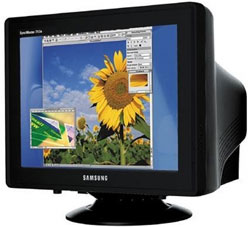
• CRT (Cathode Ray Tube or Cathode Ray Tube): consists of a cathode ray tube similar to those of a television
• LCD (Liquid Crystal Display, or LCD displays) used in most digital watches, calculators and the first laptops. They have as much contrast as CRTs.
• TFT (Thin Film Transistor, or Thin Film Transistor): offer higher performance in terms of color, contrast, viewing angle and response time than LCDs.


Operation

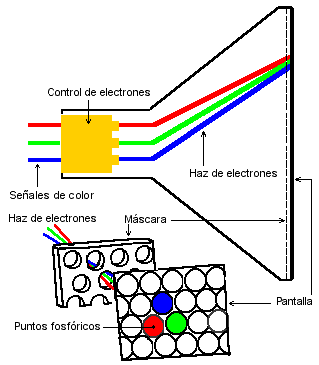
CRT: The cathode ray tube (CRT) emits an electron beam that bombards the phosphor coating lining the interior surface of the screen, standing on each pixel (graphic) so that they shine.
The beam makes a horizontal and vertical sweep, causing a trail of light of varying intensity modulated by the numerical data interpreted from the computer.
The color monitor, the CRT emits three electron beams, red green and blue RGB], impinging on each pixel of the screen to compose the image chromatic variables,


Benefits screens
CRT :
play allow a greater variety of colors.
Different resolutions can be adjusted to monitor.
In the opening screen monitors no vertical moire. Disadvantages
screens
CRT :
occupy more space (the more thoroughly the better geometry).
Older models have a curved screen.
Electric fields affect the monitor (the image vibrates).
To enjoy a good image adjustments required by the user.
In the opening screen monitors can be seen several power lines very fine and difficult to see across the screen horizontally, you can see white background.

Technical data, comparing himself:
In the CRT, the refresh rate is the one with the motherboard, the LCD is not always that you can send
CRTs be progressive and interlaced mode, the LCD has a different method of representation. In the CRT
lost about 1 inch size, used for fastening the tube, the CRT is pretty much occupied by the LCD.
The weight of an LCD is increased by the stand for stability, but the monitor itself weighs practically nothing.
LCDs usually require a transformer external monitor, the CRT goes all the electronics inside the monitor. In the LCD
consumption is lower, and the tension of use by the electronics as well.
In the CRT can be problems of "burn" the phosphor screen, this happens when you leave a still image for long, as the word "insert coin" in the recreation in the LCD problems may be defective pixels ( always on or always off), in addition to other damages.
The flashing of both types of screens is due to the low refresh rate, coupled with the persistence of the brightness of the phosphor, and the memory of each pixel on a CRT and LCD, respectively, to mitigate this defect.
With low refresh rate and a big time match persistence, no flashing, but the persistence of phosphorus is low and the drink is low, this problem occurs. Without emabargo this effect can cause fainting or blurred vision, to stay still on one point, the next screen refresh.

monitors Classes
monitors can be classified by: For the number of colors:
Monitor Monochrome (single color) Monitor
polychromatic (color)


For the signal type to display:
1 .- Digital Monitors:

CGA EGA Monochrome

2 .- Analog Monitors:

Fixed frequency multifrequency VGA


Types of monitors for resolution:

TTL: is text only, they are usually green or amber.


CGA: Son de 4 colores máximo o ámbar o verde, son los primeros gráficos con una resolución de 200x400 hasta 400x600.


EGA: Monitores a colores 16 máximo o tonos de gris, con resoluciones de 400x600,

600x800.


VGA: Monitores a colores de 32 bits de color verdadero o en tono de gris, soporta

600x800, 800x120


SVGA: Super VGA Known as q increases the resolution and the number of colors from 32 to 64 bit true color, 600x400 to 1600x1800.


UVGA: not vary much from Super VGA, only increases the resolution to 1800x1200.


XGA: are high-resolution monitors, special design, graphics capability is very good. In addition the number of colors is larger.


DIGITAL: These monitors receive data through a 9-pin connector. Each pin drives a different kind of signal. Signs include red, green and blue, red side, green secondary, secondary blue, horizontal sync, vertical and tierra.Las signals are transmitted in two states on and off. Digital monitors standard barrel has 3 electron guns in the front of the screen. These guns are called red, green and blue and emit electrons on pantalla.Cada gun shoots only at points of a particular gun. Each gun responds to signals sent to one or two pin monitor connector jack. When a signal is transmitted to pin red, red cannon shoots the red phosphor screen and the spot ilumina.La intensity of light emitted by the phosphor, is interpreted by the human eye and brain, is directly proportional to the number electron impact on rojo.Cuando point the monitor is turned on each point is in one of three states: On, off or on intense. These monitors display a fixed number of colors. The standard signal takes off a voltage from 0 to 0.8v. The signal carried on a voltage of 0.8 to 3.5V voltages are dependent on the particular monitor. The largest number These color monitors that can display are 64. This is imposed by the design of the monitor, not the monitor adapter.

ANALOG: These monitors receive data through a 15-pin connector. Each pin carries different signals. Signs include red, green, blue monitor signals zero, one and two, horizontal sync, vertical and earth.

Parameters screen


Pixel: Smallest unit representable on a monitor. Dot
or (dot pitch): The point size is the space between the colored phosphors of a pixel. Is a parameter that measures the sharpness of the image, measuring the distance between two dots of the same color, it is essential to large resolutions. The smaller spot sizes produce smoother images. A monitor of 14 inches
usually has a dot pitch of 0.28 mm or less. Sometimes it is different in vertical than horizontal, or is an average value, depending on the particular arrangement of colored dots on the screen, and the type of grid used to direct beams of electrons. In LCD and CRT grille opening is the horizontal distance, while the shadow-mask CRT, it is nearly diagonal. The minimum requirement now is to be of 0.28 mm. For CAD
or on the design, ideally of 0.25 mm or less. 0.21 in shadow mask is the equivalent of 0.24 in opening grid.
Useful area: The screen size does not match the actual area used to represent the data.
Max Resolution: is the highest resolution or native (and only) in the case of the LCD which is capable of representing the monitor is related to the size of the screen and point size
Screen Size: is the diagonal distance of a vertex opposite the screen, which can be different from the visible area.
Bandwidth: maximum frequency is able to support the monitor or
Hz vertical refresh rate: are 2 values \u200b\u200bbetween which the monitor can display images on the screen steady.
Hz and horizontal refresh rate: similar to above but horizontally, to draw each line of the screen.
Armor: A monitor may or may not be shielded against external electrical interference and be more or less sensitive to them, so if you are blind or semiblindado take the back cover virtually all the metal in an iron tube contant with earth or ground.
Monitor Type: CRT in there may be 2 types of open grille or shadow mask.
Power Lines: are horizontal lines, which have the opening screen monitors to keep the lines that show the colors perfectly aligned, in 19 "usual usually 2, but there are also 3 lines, some small monitors even have one.


Resolutions:

resolution screen is called the number of pixels that can be located in a particular screen mode. These pixels are in turn divided by the total horizontal and the vertical.
All monitors can work with multiple modes, but depending on monitor size, some of us will be more useful than others:
In general we recommend the following: